

When Sky married Earth: ancient theology in the Negev Desert
In the ancient Near East, fertility was not a natural given. It was a theological achievement—the product of a cosmic union that had to be invoked, enacted, and renewed. The logic was precise: the sky was male, the earth was female, and rain was the life-giving act that joined them. Without the sky’s descent to fertilise the earth, crops would not grow, herds would not multiply, and the communities that depended on both would perish. The hieros gamos—the sacred marriage, the holy union of heaven and earth—was the ritual mechanism by which this cosmic necessity was addressed: a ceremonial enactment of the divine union, performed by human representatives of the gods, designed to compel nature’s cooperation by imitating in the human realm what needed to happen in the divine one.
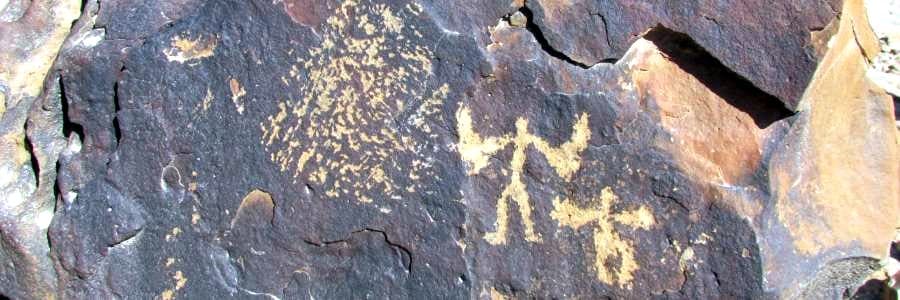
This theology reached the Negev Desert. The rock art panel discussed in this article depicts two feathered divine figures standing with arms extended toward a dotted cloud from which rain pours onto the earth below. It is the hieros gamos rendered in the schematic visual language of the desert corpus: a sky god and an earth goddess, identified as divine by their feathered bodies, performing the ritual prayer for rain whose outcome was the fertile season on which desert survival depended. The panel is not an illustration of a myth. It is a record of the theology that made rainfall cosmologically intelligible.
The Hieros Gamos: Cosmic Structure and Ritual Practice
The sacred marriage was among the most widely documented religious rituals of the ancient Near East, attested in Sumerian, Babylonian, Canaanite, and Israelite sources across more than two millennia. Its theological foundation was a cosmological model in which the sky and earth were understood as gendered, complementary principles whose union was the necessary precondition for agricultural fertility: rain, vegetation, the growth of crops, and the multiplication of livestock. The ritual enacted this cosmic principle through human surrogates: the king or high priest represented the male sky deity, while a woman—a priestess, the goddess’s representative on earth—represented the female earth principle. Their union in the sacred precinct was understood as efficacious at the cosmic level: the performance below called forth the fertility above.
In Sumer, the New Year ceremonies held in autumn—the season when the rains were expected—included the rites of holy matrimony as their central sacred act. The king represented Dumuzi, the shepherd god of vegetation and renewal, who mated with the high priestess embodying Inanna, the sky goddess whose descent to earth brought the rains and the growing season with her. The timing was theologically precise: the ceremony took place at the moment in the annual cycle when the cosmic marriage needed to be renewed, the moment before the rains either arrived or failed. The ritual was not a commemoration of something that had happened in mythological time. It was an intervention in present time, designed to produce a specific agricultural outcome.
In Canaan, the equivalent ritual centred on Baal and Asherah—the storm god and the earth goddess whose union was the Canaanite equivalent of the Sumerian hieros gamos. The ritual was performed at high places, on hilltops, under sacred trees— liminal locations between earth and sky where the distance between the human and divine realms was considered most permeable. The Hebrew prophets condemned these practices with particular vehemence, which is itself evidence of how widely they were observed. Hosea’s accusation is the most direct textual witness: “On the mountaintops they offer sacrifice and on the hills, they burn incense, beneath oak and poplar and terebinth, because of their pleasant shade. Therefore your daughters prostitute themselves and your daughters-in-law commit adultery” (Hosea 4:13). The condemnation targets the ritual participants—the women who served in these ceremonies were called Qadesh, “the blessed ones”—but the theological logic it was attacking was ancient, widely shared, and grounded in a cosmological model of fertility that the prophetic tradition sought to displace rather than simply describe.
The Negev Panel: Divine Figures, Feathered Bodies, and the Rain Cloud
The Negev panel (Fig. 1) translates this theology into the spare visual language of the desert engraving tradition. Its central elements are three: two standing figures identified as divine, and a dotted cloud from which rain descends to the earth below. Each element encodes a specific theological content.

The two figures are a man and a woman—the male sky deity and the female earth goddess, the participants in the cosmic marriage whose union the panel commemorates or invokes. Their divinity is marked by their feathered bodies. In the iconographic vocabulary of the ancient Near East and the Negev rock art corpus, feathers are a consistent marker of divine or supernatural status: the capacity to inhabit both the earthly and the celestial realm, to move between worlds, to carry the power of the sky into the human space below. A feathered body is not a human body wearing a costume. It is a divine body encoded in the visual grammar that the Negev engravers used to distinguish beings of different ontological orders from one another.
Both figures extend their arms—toward the cloud, toward the rain, toward the earth below. The gesture is simultaneously prayer and welcome: an invocation directed upward and a reception directed downward, the two movements of the hieros gamos encoded in a single bodily posture. The sky god calls down what the sky must give; the earth goddess receives what the earth must have. Their arms-extended posture is the visual equivalent of the ritual act—the sacred marriage rendered not as physical union but as the cosmic exchange that is its agricultural consequence.
Above the figures, the dotted cloud is the panel’s most concrete element. Dots in the Negev rock art tradition consistently represent rain—individual drops rendered as discrete marks, the collective fall of water from sky to earth made visible as a pattern. The cloud is no mere atmospheric background but the proof of the ceremony’s efficacy: the rain is already falling, the divine union has already produced its desired effect, and the ground receives the promise of the fertile season. The panel does not show the sacred marriage in the act of performance. It shows its outcome—the moment at which the cosmic prayer has been answered and the rain descends.
Conclusion
The Negev panel participates in one of the oldest and most widely distributed theological traditions of the ancient Near East: the belief that fertility must be solicited from the divine realm through ceremonial enactment of the union between sky and earth. From the Sumerian New Year to the Canaanite hilltops, this theology structured the relationship between human communities and the agricultural cycles on which they depended. The Negev engravers brought it into their own corpus with the formal precision that characterises the tradition throughout.
What the panel preserves is not the ritual itself but the cosmological argument behind it: that sky and earth are gendered and paired, that their union produces rain, and that rain is the life essence from which all fertility springs. The feathered figures standing with arms extended toward the dotted cloud encode that argument in the minimum visual means available—two divine bodies, one cloud, the descent of water from sky to ground. In the Negev, where all fertility hinges on whether the rains arrive, the cosmic marriage was no abstract proposition. It was the most urgent practical reality of the year, engraved on the rock where that urgency could be expressed, remembered, and returned to each season before the sky opened or did not.
Related reading
© All rights reserved. This material may not be published, broadcast, rewritten, or redistributed in whole or part without the express written permission of negevrockart.co.il
Yehuda Rotblum (2020)
