

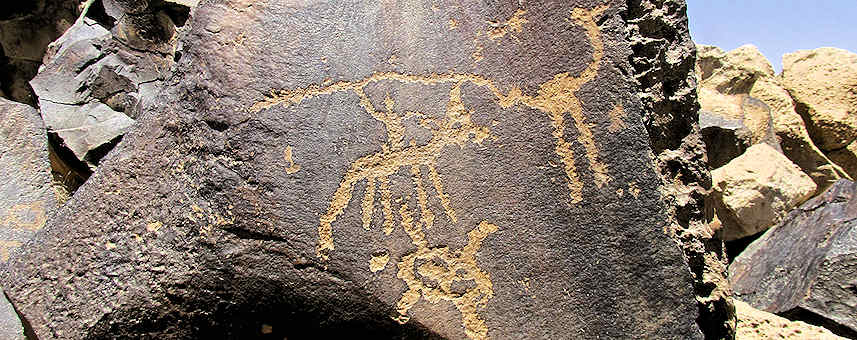
Birds in Negev Rock Art: Sky Messengers and Guides of the Soul
In ancient thought, birds move freely between the lower and upper worlds — a mobility that made them natural figures in myths of death and renewal. Wherever they appear in scenes marking that transition, their role is consistent: to soften its finality by binding it to the promise of rebirth.
This mythic capacity is emphasized even further in water birds: creatures that move between water and air— between the medium of the underworld and the medium of the sky—embody in their own bodies the complete vertical structure of the cosmos. The swan, the crane, the stork, and the duck are not merely birds: they are living bridges between the realms. Their presence in afterlife iconography reflects the recognition that they are capable of completing the entire journey to the afterlife.
This capacity for movement between realms is what grants birds their status as symbols of transcendence. Across the Negev corpus, that status recurs—worked into hybrid figures, attached to the sun, carried alongside the dead. What follows traces how, and why.
The Divine Helpers of the Sun
The sun, in ancient cosmological thought, is not simply a source of light. It is the supreme model of death and rebirth: a being that dies each evening, descends into the underworld, crosses its dark waters through the night, and is reborn each morning. Its daily cycle is the prototype of all renewal. Its presence in burial contexts, alongside bird-wing symbols, reflects a precise theological equation: the sun’s journey and the soul’s are one, and what helps one helps the other.
By this mythological logic, neither the sun nor the soul can complete this journey unaided. Both require divine helpers—beings capable of moving through the upper and lower waters, crossing the cosmic obstacles, and delivering their cargo safely to the realms beyond. The Negev panels document a whole range of such helpers: the mythic ship, water birds, the sun chariot, and the tri-fingered birds. These are not interchangeable—each operates in its own cosmological register and fulfils a defined role within the journey. Yet their missions converge on the same route, confront the same dangers, and drive toward the same destination (Kristiansen 2018).
The correspondence between water birds and the afterlife journey is documented in Egyptian and Indo-European Bronze Age traditions, with a consistency that points to a shared cosmological understanding rather than coincidence. Fig. 1 lays out the comparative evidence directly: swan boats in the Bronze Age rock art of Tanum, Scandinavia (Ling & Uhnér 2014); tri-fingered solar helpers from the Bronze Age iconographic record (Kristiansen 2018); Apollo’s solar chariot drawn by swans (Bilic 2016); and a Negev day-and-night ship with a swan-shaped prow and stern. The swan, the tri-finger, and the sun ship all appear together across a geographic span stretching from the Negev to Scandinavia. What connects them is not cultural contact alone, but a shared understanding of the water bird’s purpose.

The Bird Merged into a Figure
Negev bird imagery takes several forms. Some engravings show complete birds; more often the representation is partial—a head, a mask, or wings attached to a human figure. The full-bodied birds that do appear are consistently large species—storks, cranes, swans, ostriches—whose scale implies the capacity to carry something, or someone. Hybrid figures recur throughout the corpus: humans with bird beaks, winged hunters, human figures with bird heads. Each one marks a threshold between the human and the divine, between the earthly and the heavenly.

These hybrid figures are not artistic shorthand for “divine.” Each one borrows a specific capacity from the bird, and the particular trait chosen tells the viewer exactly which capacity is being transferred. For example, in scene 1 the figure is the god Baal, taken from the rock art of the Baal Cycle—he is not a bird; here he is marked as a being entitled to the cosmic authority the scene depicts. Baal’s identity as a deity is that of the storm god who ends drought and restores the land’s fertility.
A different capacity is borrowed in scene 2: the hunter with a bird’s head. This is the myth of the sun’s journey itself—the moment the sun passes from the visible sky into the underworld, the most dangerous crossing in its daily cycle. An ordinary hunter is not qualified to touch that moment; only one who already crosses between realms is permitted to. The bird’s head does not turn the hunter into a bird—it authorises him, granting passage at exactly the moment the sun needs it most.
From Full Bird to Sacred Sign: The Tri-Finger Symbol
Against the bird’s full-bodied form, the tri-finger symbol is an act of visual reduction: rather than the whole creature, the engraver preserved only its feet—three forward-pointing toes marking its point of contact with the ground and, by extension, the three realms it crosses. The leg that touches earth is the same leg that rose from water and will rise to sky. Reduced this far, the sign becomes portable: it can be attached to the sun, placed beside a soul, or mounted on a ship without overloading the scene—a shorthand carrying the bird’s full meaning in a minimum of visual space.

Fig. 3 presents the range of compositional contexts in which the symbol appears. In its simplest form, the three toes stand alone—a self-sufficient sign requiring no elaboration. In other rock art it appears beside the sun, marking the bird as a solar helper, one of the divine helpers whose task is to lead the sun through its dangerous nightly crossing. In one panel it appears with the moon, extending its protective role over the nocturnal realm. Most tellingly, in one panel the tri-finger carries a soul—represented by a horizontal line— confirming its role as psychopomp in the most literal sense.
Bird as a Cross sign
Alongside the tri-finger symbol, Negev rock art offers another reduction of the bird—this time not as its feet, but as its shape in flight. In many rock art panels the sun does not appear as a disc or a circle, but as a simple cross—a vertical line crossing a horizontal one. Its shape is not arbitrary: it is the image of a bird seen from below at the moment of flight, its wings spread flat. The bird’s dwelling in the sky corresponds to the sun’s place. The sun and the bird are compressed together as a cross, into one economical sign.

The cross form in Negev rock art appears in several variants: a simple cross, a rayed star, a cross within a square, or a symbol positioned above or between an ibex’s horns. This variety shows how the engravers expressed a single concept in different ways, while the underlying meaning remained clear and stable over time.
Death without burial and the Tri-Fingered Birds
The logic outlined in the discussion of the tri-finger symbol—its role as psychopomp—finds its sharpest, most focused expression in a single panel. The task of rescuing the soul was especially urgent in the case of battlefield death without the possibility of proper burial: textual and iconographic evidence from early Iron Age European and Mediterranean traditions document the belief that warriors fallen in battle required divine intervention to reach the afterlife—an intervention that the bird, and psychopomp figures generally, were specifically meant to fulfil. Fig. 5 embodies this principle in a single Negev panel.
The image shows a horse and its rider falling to the ground—the standard iconographic representation of death in combat across the ancient Near East. Three tri-finger symbols appear in direct compositional relationship to the fallen figure: one connected to the sun, one carrying a soul, and one flying toward the sun. The ibex beneath the horse, representing the principle of fertility and the hope of renewal, provides the theological counterweight. The scene encodes an entire afterlife theology in miniature: death without burial, divine rescue, solar ascent, and the promise that even an unburied warrior will reach his destination.

The Complete Soul Journey assisted with a bird
Fig. 6 represents the most complete synthesis of the themes traced in this article. The panel unfolds across two physically distinct rock surfaces—a darker lower face and an illuminated upper part—and the engraver has used that physical distinction as a cosmological one. The lower surface is the underworld; the upper surface is the celestial realm. The composition does not merely depict the afterlife journey. It is spatially enacted by the rock itself.

At the centre stands a bird with flat feet—the morphological marker of a water bird—carrying a baby with its beak: the soul promised a rebirth. On the left, moon marks the onset of night, the beginning of the solar descent into the lower waters and the start of the underworld crossing. A snake winds through the underworld and crosses the horizontal boundary separating earth from the heavens—the obstruction figure whose role is to threaten the solar passage, originating in Egyptian mythology. The bird carries the baby alongside the sun itself, which at that same moment is deep within the underworld, undergoing its own cycle of renewal. Together they cross the danger the serpent poses, on their way to that same boundary. In Egyptian theology, the sun’s rebirth is completed specifically at the horizon—not within the underworld itself (Hornung 1999; Roberson 2008).
We have encountered every element in this composition separately in the previous panels. Here they converge: the water bird at the cosmic centre; the moon marking the opening of the night journey; the serpent as the force of obstruction; the horizontal boundary between the realms; the sun as the destination of the passage; and the soul as the cargo. This is not a chance assembly of symbols, but a complete theology, arranged with the precision of someone who knew exactly what each element meant and exactly where its place was in the cosmic order.
Conclusion
The evidence assembled here describes two convictions that the Negev engravers treated as inseparable, not as ideas loosely juxtaposed. The first is that the bird is a solar creature. The solar cross of the Negev corpus is, quite literally, a bird’s outstretched wings, and no clean line separates the sign from the creature it depicts. The second is that the bird is a psychopomp— moving as it does through every register of the cosmos, earth, water, and sky, it is uniquely suited to carry what the earthbound cannot carry themselves.
The two are, in the end, one theology told twice: solar birds, water birds, hybrid figures, the tri-finger sign, and the sun-cross itself all point back to a single figure at the centre of Negev afterlife belief. The engravers who scratched wings, beaks, and abstracted feet into desert stone were not working from a local superstition. They were recording, in their own visual language, one of the oldest and most widely shared convictions in human religious thought—wings spread flat against the rock, standing at once for the sun and for the soul it carries.
That lineage reaches back further than the rock art itself. Twelve thousand years before these lines were cut into stone, a woman was buried at Hilazon Cave in the Galilee with the wing of a golden eagle laid at her feet—one of the earliest known shaman burials in the region (Rotblum 2026). The tri-finger is that eagle reduced to its footprint, the calling card it leaves at every threshold. The form changed, from a complete wing laid beside the dead to three lines scratched into rock, but the underlying conviction did not: the bird guides the soul, and its print is proof that the guide has passed this way.
Related reading
Bibliography
Bilic T. (2016) The swan chariot of a solar deity: Greek narratives and prehistoric iconography
Hornung, E. (1999) The Ancient Egyptian Books of the Afterlife. Translated by David Lorton. Ithaca, NY: Cornell University Press.
Kristiansen Kristian (2018) The winged triad in Bronze Age symbolism: birds and their feet
Ling and Claes Uhnér (2014) Rock Art and Metal Trade
Roberson, J. (2008) The Rebirth of the Sun: Mortuary Art and Architecture in the Royal Tombs of New Kingdom Egypt. Expedition Magazine, 50(2). University of Pennsylvania Museum.
Rotblum, Y. (2026) Rock Art That Shook the Earth, discussing Grosman, L., Munro, N. D., & Belfer-Cohen, A. (2008) A 12,000-year-old Shaman Burial from the Southern Levant, Proceedings of the National Academy of Sciences, 105(46), 17665–17669.
© All rights reserved. This material may not be published, broadcast, rewritten, or redistributed in whole or part without the express written permission of negevrockart.co.il
Yehuda Rotblum (2020)
