

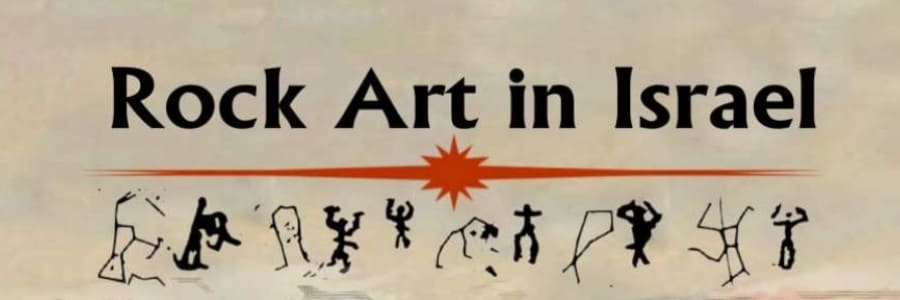
Interpretations and decipherments of prehistoric rock art in the Negev Desert
The Negev Desert preserves one of the most extensive and least understood bodies of rock art in the Near East. Thousands of petroglyphs, engraved across the desert's rock surfaces over more than two millennia, have long resisted systematic interpretation. Part of the difficulty is methodological: these images are not accompanied by inscriptions, and conventional approaches that treat rock art primarily as a record of hunting, herding, or daily activity leave most of the corpus unexplained. Rock Art in Israel proposes a different framework. The engravings are not depictions of daily life. They are a record of religious beliefs — cosmological, astronomical, and mythological — shaped by sustained contact with the theological traditions of Egypt and Sumer.
What the Book Covers
The book is organised across five chapters and presents its interpretations through 147 figures that set the Negev petroglyphs alongside comparative material from the broader Near Eastern and Mediterranean world. The chapters address four intersecting domains: mythology, astronomy, archaeology, and decipherment — each contributing to the overarching argument that the Negev rock art corpus represents a sophisticated and internally consistent religious tradition.
The astronomical material is among the book’s most original contributions. The Negev engravers tracked the lunar cycle with precision, and the book documents how they constructed permanent stone calendar instruments — some of the earliest such devices known from the region — that could be operated independently of direct sky observation. The cosmological material is equally distinctive: the book reconstructs how these communities conceptualised the creation of the world and encoded that cosmogony in engraved form.
The mythological chapters identify specific Canaanite, Egyptian, and Mesopotamian narrative traditions in the Negev corpus — including the solar journey of Ra through the underworld, as documented in the sun journey panels, and the funerary theology of the afterlife passages in which birds, ships, and psychopomp figures guide souls through the cosmic waters. The hunting scenes and fertility imagery are similarly reinterpreted: not as secular records of pastoral life but as ritual expressions of cosmological principles, with the ibex and other animals functioning as symbolic rather than simply representational figures. The mythology chapters bring the Ugaritic and Canaanite material into direct conversation with the desert engravings.
The Interpretive Approach
The book’s central methodological contribution is the systematic application of comparative iconographic analysis to a corpus that has previously resisted it. The Negev engravers did not work in isolation. Their symbolic vocabulary shows consistent and specific parallels with Egyptian funerary iconography, Mesopotamian astronomical traditions, and Canaanite mythological narrative — parallels too precise and too numerous to be coincidental, and which reflect the long-distance cultural and commercial networks that connected the Negev to the wider civilisations of the ancient Near East.
This contextualisation does not reduce the Negev material to a pale reflection of its neighbours. What the comparative analysis reveals is a tradition that received influences from multiple directions and synthesised them into something distinctively its own — selecting, adapting, and re-encoding shared theological content in the spare schematic visual language of the desert corpus. The engravers were not copying. They were thinking, in stone, with the same cosmological problems that preoccupied the great civilisations on every side of them.
Examples of specific decipherments are available in the Articles section of this website, where individual panels from the corpus are analysed in detail. The full interpretive framework, the complete catalogue of 147 figures, and the systematic comparative argument are presented in the book, available online.
Related reading
© All rights reserved. This material may not be published, broadcast, rewritten, or redistributed in whole or part without the express written permission of negevrockart.co.il
Yehuda Rotblum (2020)
