


A Cosmology Engraved in Stone
For over a century, the rock art of the Negev Desert resisted interpretation. Thousands of petroglyphs, engraved across the desert's limestone and sandstone surfaces over more than two millennia, were catalogued, photographed, and debated — and left unexplained. The problem was not a shortage of material. It was a shortage of method.
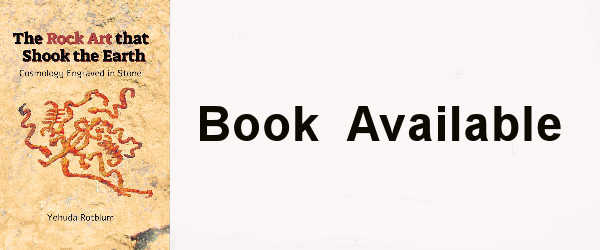
The Rock Art that Shook the Earth cracks the code. Drawing on twenty years of fieldwork and a systematic comparative analysis of Egyptian, Mesopotamian, and Canaanite religious traditions, Yehuda Rotblum demonstrates that the Negev engravings are not primitive decoration or casual records of desert life. They are a complete cosmological system — a structured understanding of the universe in which celestial cycles, seasonal survival, creation mythology, and the soul's journey after death are encoded in a single, coherent visual language cut into stone.
What the Book Argues
The interpretive key came from geography. The Negev lay at the intersection of the ancient Near East's dominant powers for centuries — Egypt to the south, Mesopotamia to the north and east, Canaan mediating between them. These were not distant influences. They were direct and consequential. The engravers absorbed the great religious traditions of the Fertile Crescent and encoded them in stone, far from the temples and scribal workshops of the great civilisations, but thinking with the same cosmological problems those civilisations had identified and answered. The result is a corpus that can be read — panel by panel, symbol by symbol — once you know what to look for.
What the Book Covers
The book is structured across four intersecting domains, each presenting the evidence for a specific area of the corpus through 83 comparative figures that set the Negev petroglyphs alongside material from across the ancient Near East and Mediterranean world.
The astronomical chapters document how the engravers tracked the sky without writing, without institutions, and without instruments — constructing permanent stone calendar devices, encoding the eight-year Venus cycle with mathematical precision, and mapping the winter constellations in their correct spatial relationships from the North Star to the ecliptic. These are among the earliest such records known from the region.
The mythological chapters identify specific narratives encoded in the panels: the solar journey of Ra through the underworld, documented in the sun journey panels; the afterlife passage in which birds and boats guide souls through the cosmic waters; the Baal–Mot cycle of seasonal death and return; and the sacred marriage theology that connected the sky and the earth through ritual. The ibex — the corpus's central symbol — is revealed as a local encoding of Orion and Osiris, its seasonal behaviour in the desert synchronised precisely with the astronomical events it represents.
The archaeological chapters ground the corpus in its historical context: the Shasu pastoralists of the southern Levant, the desert sanctuaries and standing stones, the solar-oriented hilltop temples, and the Proto-Sinaitic inscriptions that record — three centuries before the earliest biblical texts — the divine name of the God of Israel engraved in the desert where the tradition originated.
The decipherment chapters bring the evidence together, showing how individual panels encode multiple layers of meaning simultaneously — astronomical, mythological, and seasonal — in the spare visual language of desert engravers who had neither papyrus nor clay, but had stone, and knew exactly what to cut into it.
Why It Matters
The book makes three claims that reach beyond the desert itself. It demonstrates that the communities of the Negev were genuine intellectual participants in the religious life of the ancient Near East, not passive recipients of outside influence. It shows that Bronze Age cosmological knowledge was far more widely distributed than literate sources alone suggest. And it establishes that the religious history of ancient Israel is not fully contained in the biblical texts — that what the desert rock preserves preceded the scripture, shaped the world from which it emerged, and survived every attempt to erase it. The rock art was there before the scripture. It is still there.
Related Reading
© All rights reserved. This material may not be published, broadcast, rewritten, or redistributed in whole or part without the express written permission of negevrockart.co.il
Yehuda Rotblum (2020)
